
Youth Parade
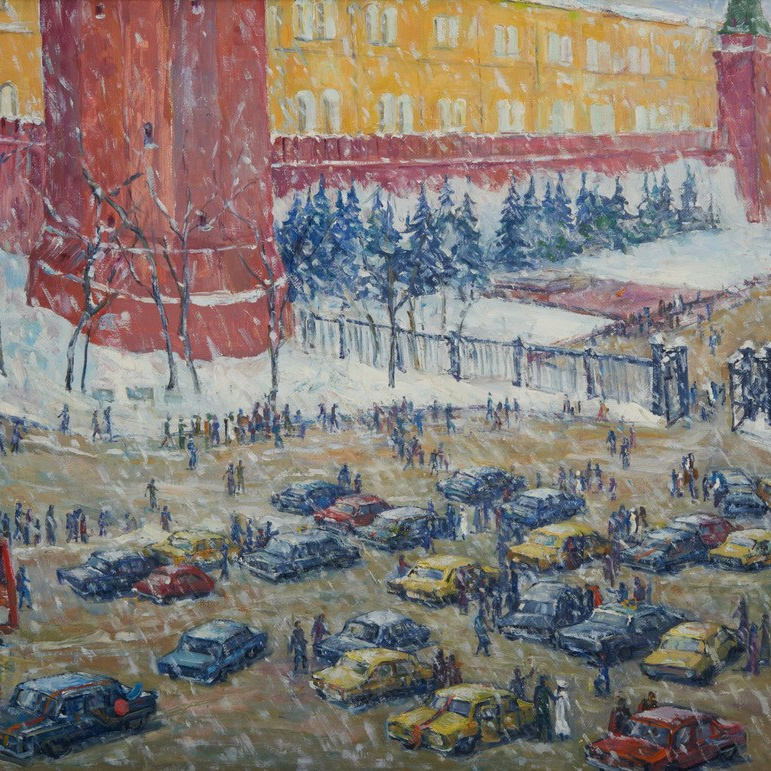
This place, my father has said, he first spotted while sitting in a nearby restaurant. He liked it, remembered it, and even took a photograph. Later, working from the photograph, he made a drawing. He decided, however, to paint it from life.
He drove to the spot in his Zaporozhets and parked near the Hotel Moskva (demolished in 2004; the Four Seasons Hotel Moscow was built in its place). It is worth noting that parking in the centre was problematic even then — there were no proper parking spaces. There are spaces now, but parking in the centre remains problematic — it is simply expensive.
Having parked, my father set to work and immediately attracted the attention of a traffic officer in his booth across the square — evidently affronted by such audacity. Within a minute the officer was running towards him, waving his baton. My father, with an impassive expression, lowered the car window just enough for the canvas to be visible. To the officer’s questions about his business in the area, my father said something along the lines of: “Comrade, I have an assignment from Grishin — to paint a picture from life,” and produced some kind of artist’s identification (he was not yet a member of the Union at the time). The officer did not argue, gave a salute, and said: “Right then, carry on. I won’t mention it at the changeover — they’ll leave you alone and keep an eye on you.”
Moscow Motive. Sofiyskaya Embankment
It is remarkable how connections work. Events may seem unrelated, yet at a certain moment they converge in a single point and acquire meaning.
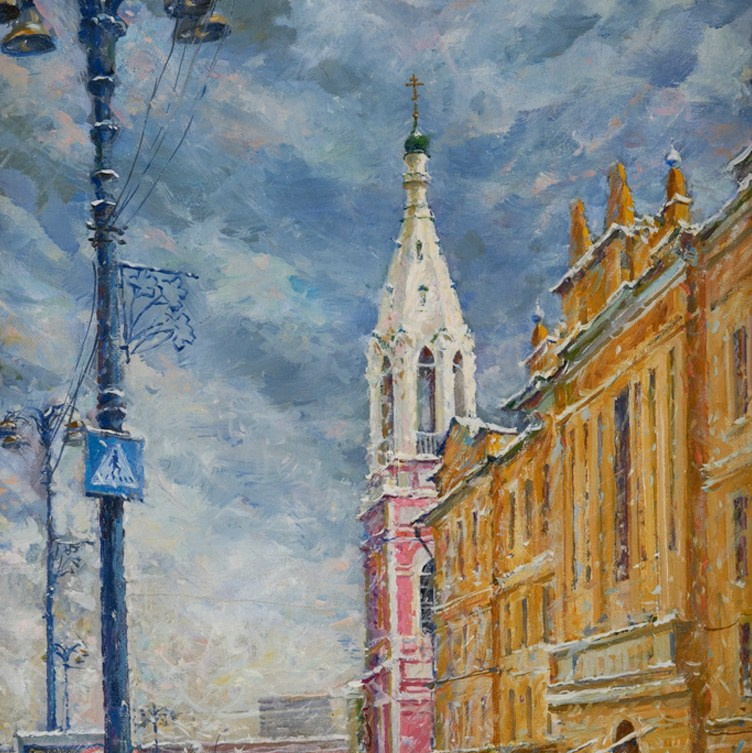
When I was working near Paveletskaya, I often came to work along the Kremlin Embankment. It was summer, and a storm was gathering. Suddenly, against the stormy sky, I saw a bell tower that seemed to glow against the deep-blue clouds.
The bell tower of the Church of Sophia in Srednie Sadovniki — a seventeenth-century church on the Sofiyskaya Embankment — rose into the sky despite the weather and the approaching storm.
That same evening I asked my father to paint that bell tower — and specifically against a stormy sky. And so the Sofiyskaya Embankment painting came into being. The subject is wintry and the angle is not quite what I had pictured, but the memory of that stormy sky now lives within the painting.
It turned out that a military unit had once been stationed near the church — a unit that had served the building of the Dzerzhinsky Academy. My father served in that same unit. There is a connection for you.
Before Christmas (Rozhdestvensky Boulevard)
Old objects carry us in a time machine back to where we first encountered them. Memory is constructed in such a way that it stores recollections in different parts of the mind. The moment you catch a particular smell, images of a place or person associated with it arise in the mind.
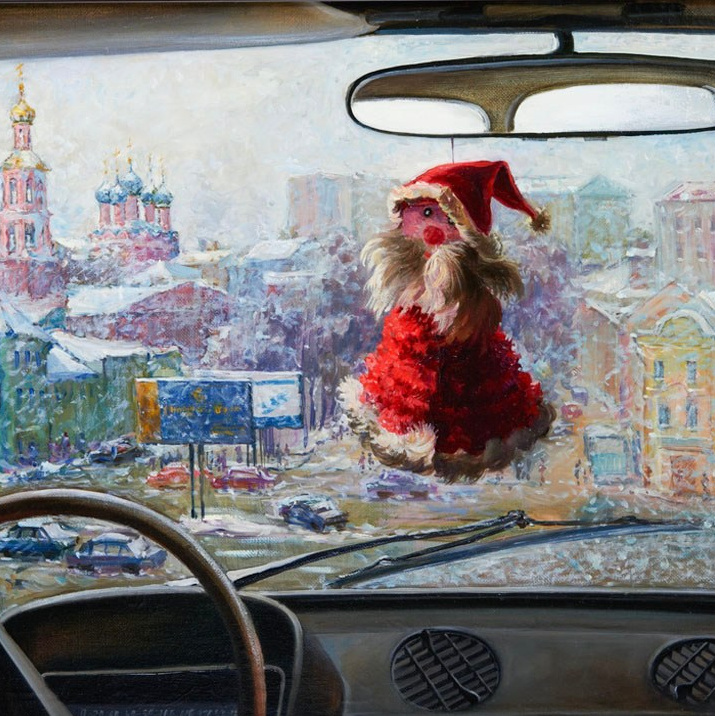
This Father Christmas “lives on” — he still resides in my father’s studio, having lost a good deal of his outer polish over the years, but he exists. Long ago, on Leninsky Prospekt, there was a shop that sold German Christmas ornaments. This Father Christmas is from Germany. Every New Year he would appear without fail on the living Christmas tree, a symbol of the holiday and its celebration.
How fortunate that there are ways to preserve memories — using mementos as keys to the past.
Tverskoy Boulevard. March
Tverskoy Boulevard came into being in 1796 on the site of the former walls of the White City. It is the oldest surviving boulevard in the capital.
City legend has it that it was at a ball in a mansion on Tverskoy Boulevard that Alexander Pushkin first saw Natalya Goncharova — his future wife. Whether this is true is difficult to say, but one of the boulevard’s trees is still known as “Pushkin’s Oak.”
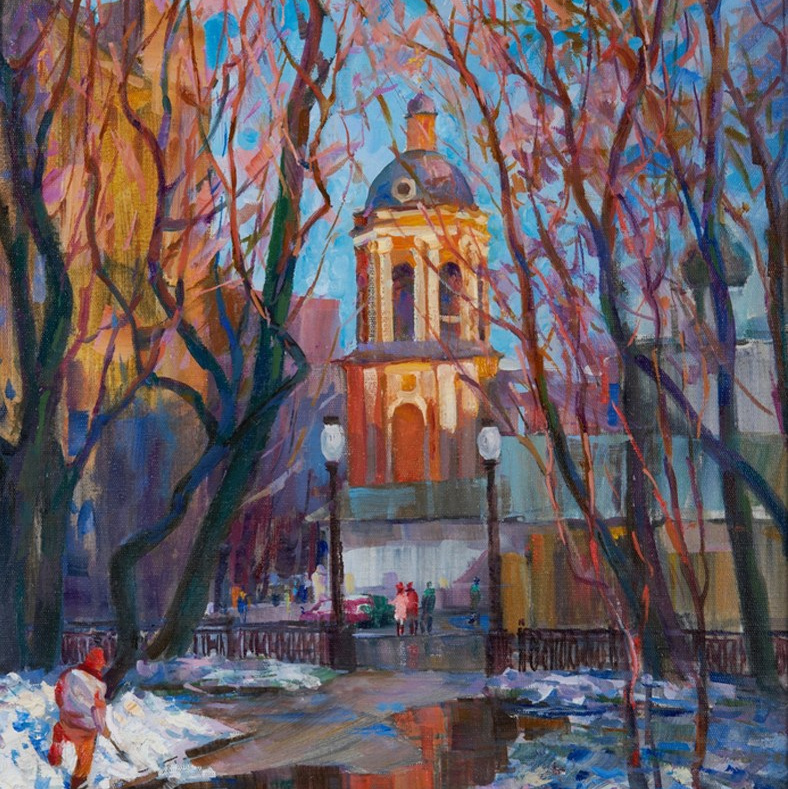
The painting “Tverskoy Boulevard. March” depicts the Church of the Holy Apostle and Evangelist John the Theologian on Bronnaya. The first surviving mention of the church — as a “single-apse wooden church of John the Theologian in the Bronnitsy, beyond the Tverskiye Gates” — appears in tithe records from 1625. Between 1652 and 1665 a stone church was built at the parishioners' expense, and in 1694 a chapel dedicated to St Nicholas the Wonderworker was added. Alexander Herzen was baptised in the Church of John the Theologian in spring 1812, and a few years later his future wife, Natalya Zakharyina, was baptised there too. In 1842 the church was rebuilt and a bell tower was erected.
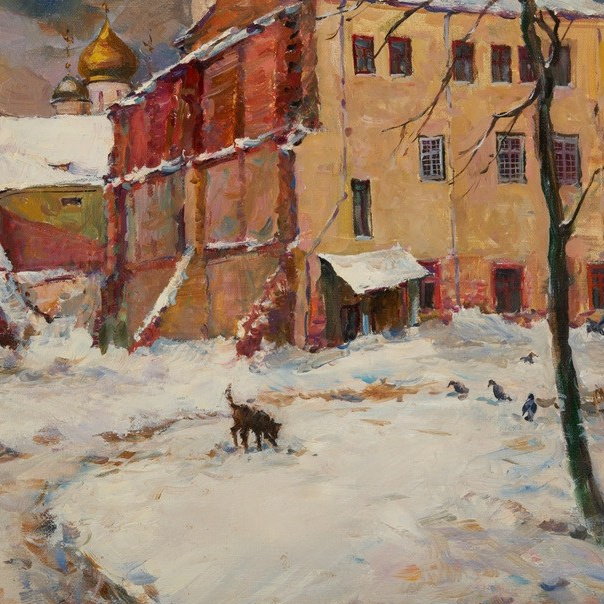
A Moscow Courtyard
I have noticed something: when I photograph someone or something, I upload the images, make my selection, file the chosen material in folders and, as it were, “clear” it from my working memory. But the moment I glance at a photograph again, memory begins to “pull up” the details of that day or event.
At the current exhibition at the Gallery on Nagornaya, we were looking over the works together with the curators. Stopping in front of “A Moscow Courtyard, ” my father described exactly how it had looked back in 1999. Today, a monolithic block stands on that spot and there is no access — but then, all manner of characters could be found sheltering there from the eyes of passers-by. A friend of my father’s mother lived in the house to the right. Coincidence, or connection? Coincidences are never truly coincidental.